


Chinese motorcycles with retail prices of several thousand dollars were imported into Russia through Belarus at declared prices dozens of times lower. The equipment travelled from China through Kazakhstan and Russia to Belarus, where it cleared customs before returning to the Russian market. In late 2025, around 100 enduro motorcycles were declared at $200 each, another shipment at about $60 per motorcycle, and 108 dirt bikes with components at roughly $80 each. From 2023 to 2025, equipment with a declared value of nearly $3 million was imported through this route. The understated value may have reduced customs duties and VAT.
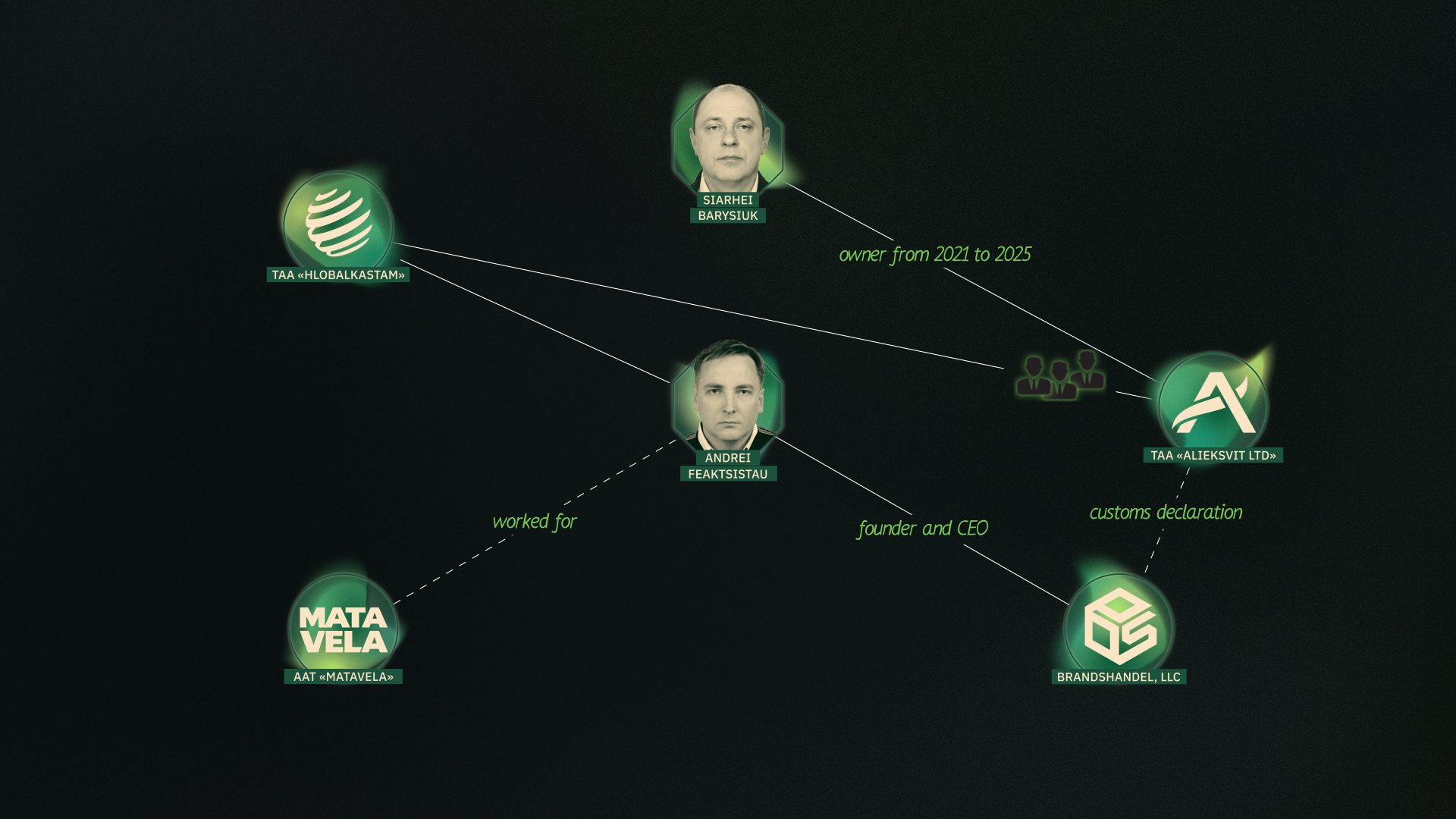
The shipments were handled by the Belarusian company Brandshandel. Its founder and director, Andrei Feaktsistau, had worked for almost ten years at companies linked to Viktar Sheiman’s inner circle. Nearly half of Brandshandel’s employees previously worked at Hlobalkastam, another Sheiman-linked company that processed imports through Belarusian customs while minimizing payments. Alieksvit Ltd, owned in 2021–2025 by former Deputy Chairman of the State Customs Committee Siarhei Barysiuk, acted as customs declarant for at least one shipment.
Documents indicate that part of the money was routed through Switzerland’s Erop Group AG and Hong Kong’s Winshun Trade Limited. In 2024, a Russian motorcycle buyer paid Erop Group AG almost $1.7 million for logistics and transportation. Winshun Trade Limited was controlled by relatives and associates of Siarhei Anoshka, a key figure in businesses linked to Sheiman. The same company had previously lent more than $10 million to Komplex-Invest, which was building a luxury chalet in Sochi allegedly for Alexander Lukashenko.
None of the parties contacted responded by the time of publication.
Chinese motorcycles worth several thousand dollars were entering Russia from Belarus at prices of just a few hundred dollars. The BIC found that companies registered in Switzerland and Hong Kong were among those involved in the shipments. Some of these companies are connected to Viktar Sheiman’s inner circle. Not only could such scheme a reduce customs payments, including duties and VAT, but it could also give Chinese competitors of the Belarusian Motavelazavod an additional advantage in one of their key markets.
This investigation was made possible by the Rabochy Ruch initiative and was produced with support from CyberPartisans.
Motorcycles at the price of a chainsaw
One of Belarusian Motavelazavod’s competitors on the Russian market is the Hasky brand, which sells Chinese motorcycles under a Russian brand name. Its models include enduro motorcycles, off-road vehicles purchased in recent years to meet the needs of the Russian military. The Belarusian manufacturer’s product line includes these models as well. The Hasky A10 PRO NX MSD has a retail price of about $6,500. However, the BIC found customs documents indicating that similar motorcycles were imported from China to Russia at prices dozens of times below retail. [*] The supply route was unusual. Instead of being shipped directly to Russia, the equipment traveled from China to Kazakhstan, then to Russia, on to Belarus, and finally back to Russia. The motorcycles underwent customs clearance in Belarus before being sent back to the Russian market.
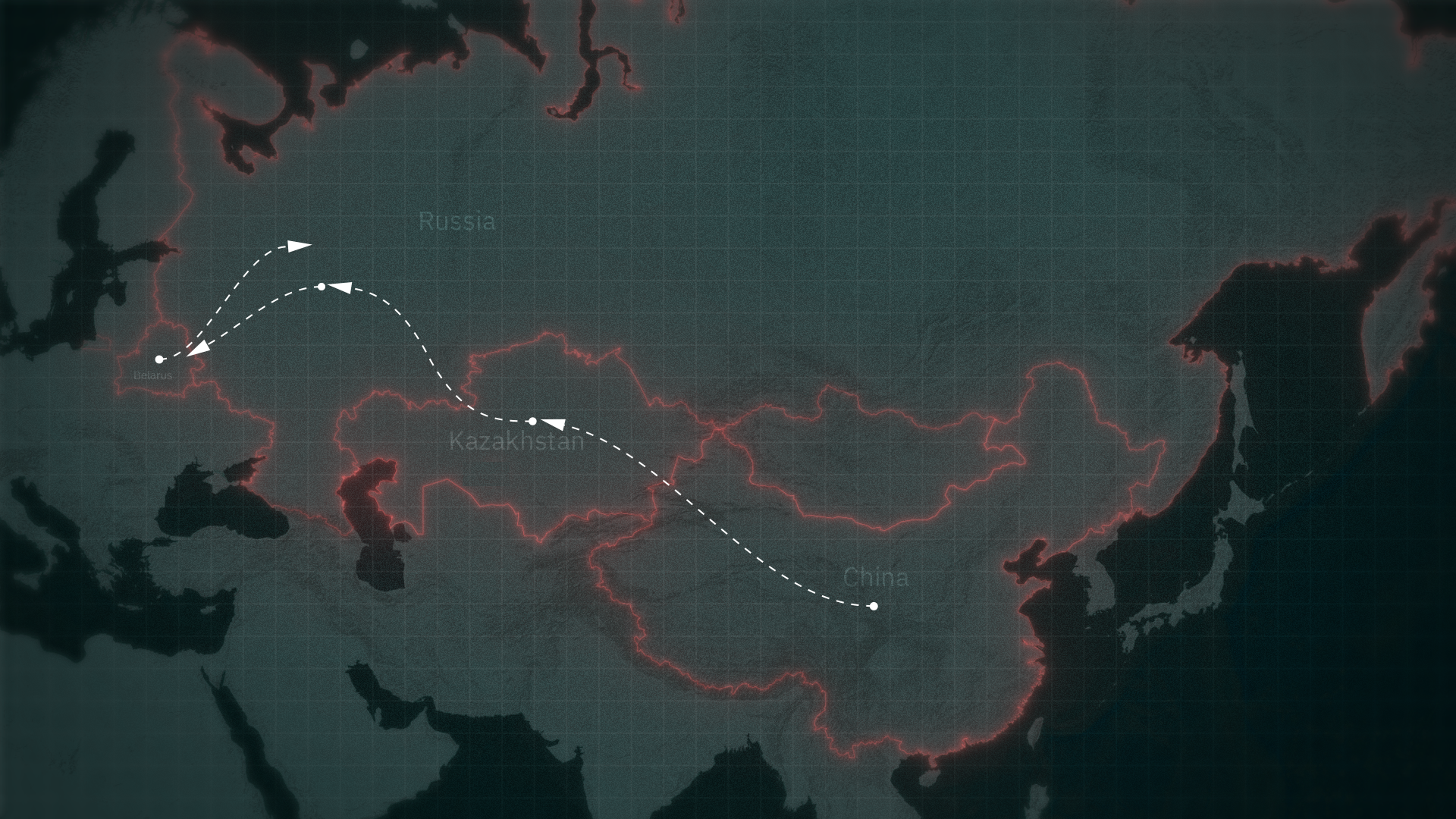
This was not an isolated incident. According to documents that we received from the Rabochy Ruch initiative, a Chinese manufacturer shipped approximately 100 enduro motorcycles to Belarus in November of 2025 at a cost of $200 each. [*] A month earlier, a shipment of motorcycles weighing more than 15 tons was imported into the country. The average price per motorcycle was approximately $60. Another shipment of 108 dirt bikes, along with components, was declared at less than $9,000, or roughly $80 per bike. [*] Over the two years from 2023 to 2025, nearly $3 million worth of equipment was imported under this scheme.
A logistics specialist who spoke with the BIC on the condition of anonymity believes the declared value of the equipment was likely artificially understated. He says this makes it possible to reduce customs duties and VAT, which are calculated based on the goods’ declared value. For example, if you declare a motorcycle worth $200, the customs duty will be approximately $28. However, if it were declared at even $2,000, the customs duties would be roughly ten times higher.
“You can’t even buy a chainsaw for €200. So how could you possibly buy a motorcycle for that? ... A motorcycle of this class weighs about 130 kilograms. At that price, I think you could only buy it as scrap metal,” the logistics specialist says.
The BIC determined that the shipments were routed through the Belarusian company Brandshandel.
The clues lead to…
The Belarusian company Brandshandel was established in February 2023. [*] Its founder and director, Andrei Feaktsistau, previously worked for nearly ten years at companies linked to Viktar Sheiman's inner circle, a close associate of Aleksandr Lukashenko. [*] Before that, he was employed at Matavela.
Feaktsistau’s biography is just one example of the connections between Brandshandel and Sheiman’s inner circle. Almost half of the company’s current employees previously worked at Hlobalkastam. The two companies were both registered at the same address on Niamiha Street in Minsk, but at different times. On paper, Hlobalkastam was owned by two women, an Academy of Arts graduate and a hairdresser from Odesa. However, as the BIC had previously established, the graduate was in a relationship with Viktar Sheiman at the time. The hairdresser, meanwhile, was married to the nephew of Sheiman’s first wife. Like Brandshandel today, Hlobalkastam made money by processing imports through Belarusian customs and minimizing customs payments, including during the period when Sheiman served as the president’s chief property manager.
In our new investigation we shed light on the key person involved in Mr. Sheyman’s dirty side hustle – as well as matters of his heart
Some of Hlobalkastam’s former employees relocated to Brandshandel, while others had earlier moved on to Alieksvit Ltd. This company has acted as the customs declarant for at least one Brandshandel shipment. From 2021 to 2025, it was owned by Siarhei Barysiuk, the former Deputy Chairman of the State Customs Committee of Belarus. [*]
The day Barysiuk became the company’s owner, Kiryl Zhukau was appointed director — a person who had previously worked for structures connected to Viktar Sheiman’s network. [*]
Brandshandel has repeatedly found itself involved in court cases concerning the failure to declare goods and the provision of false information to customs authorities. Each time, the cases resulted in administrative proceedings rather than criminal charges. While this alone does not prove preferential treatment, when considered alongside the company’s ties to Sheiman’s inner circle and former customs leadership, it helps explain how the scheme could operate without serious consequences for those involved.
Switzerland and Hong Kong
Underreporting the customs value only explains part of the scheme. If the motorcycles were recorded in the documents at face value, who made a profit? The documents reviewed by the BIC indicate that some of the money was routed through two other companies, one registered in Switzerland and the other in Hong Kong.
The first of these companies is the Swiss firm Erop Group AG. The BIC discovered that one of the Russian companies that purchased motorcycles from Brandshandel also paid Erop Group AG for logistics, transportation, and freight forwarding services. We identified nearly $1.7 million in such payments in 2024 alone.
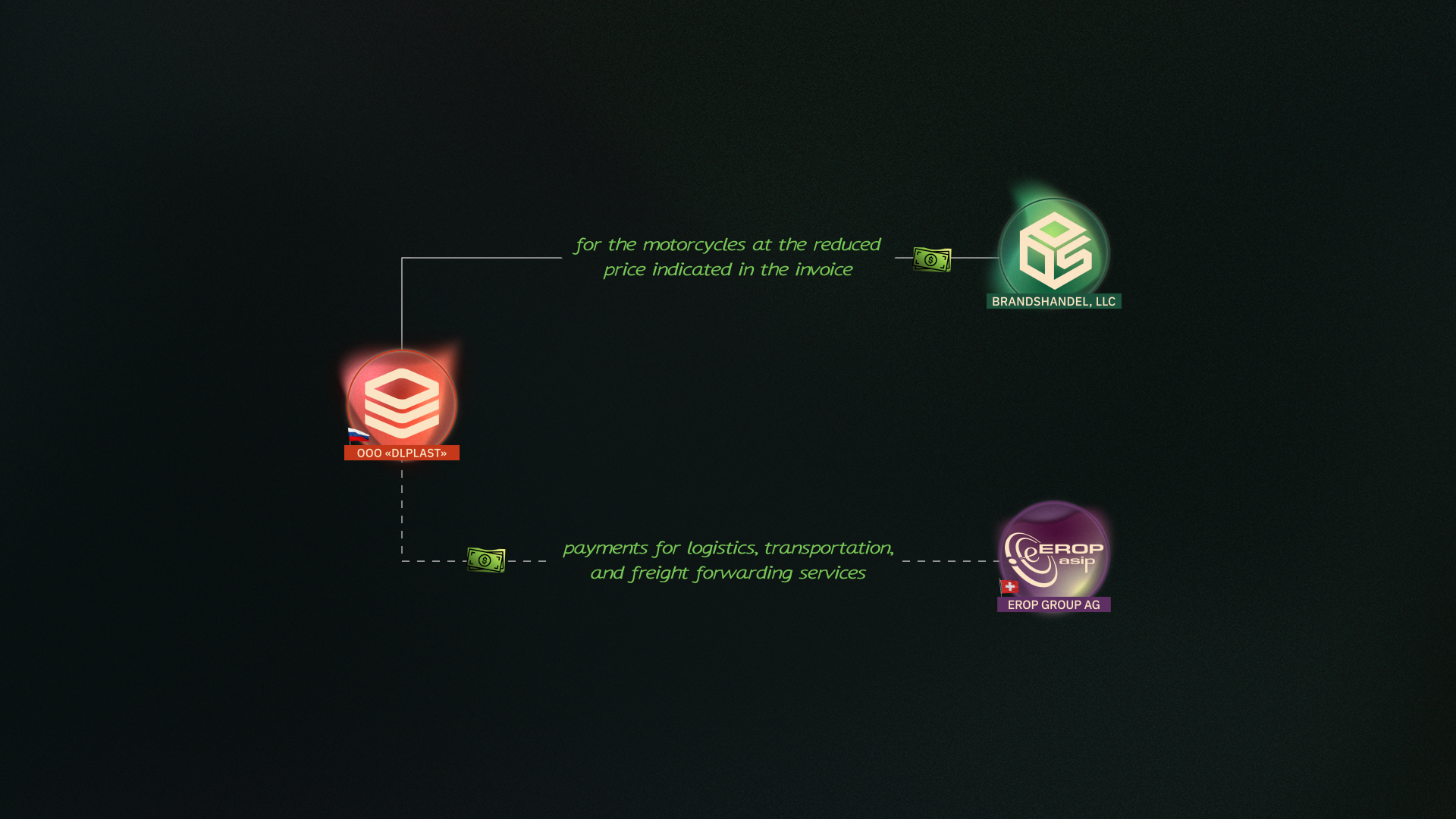
Erop Group AG was incorporated in Zug, Switzerland, a canton known for its favorable tax regime and numerous international businesses. There are several ways to trace the company’s connection to the described network. The archived website of its Belarusian representative offices lists Hlobalkastam as one of the company’s partners. Additionally, from 2023 to 2024, Alieksvit Ltd, a company that acted as the customs declarant for Brandshandel shipments at least once, was involved in shipments related to Erop Group AG.
The second company is Winshun Trade Limited, based in Hong Kong. In the shipping documents, it was listed as the purchaser of the motorcycles from the Chinese seller, just like Erop Group AG. Meanwhile, Brandshandel was listed as the consignee in Belarus. Although Winshun Trade Limited is registered in Hong Kong, it has an office in Geneva. From January 2023 to January 2024, Siargei Hrabionkin, the nephew of Siarhei Anoshka (a former Matavela manager and key figure in businesses associated with Viktar Sheiman), was the sole shareholder of Winshun Trade Limited. In 2024, Anoshka was granted a five-year power of attorney to manage the company. [*]
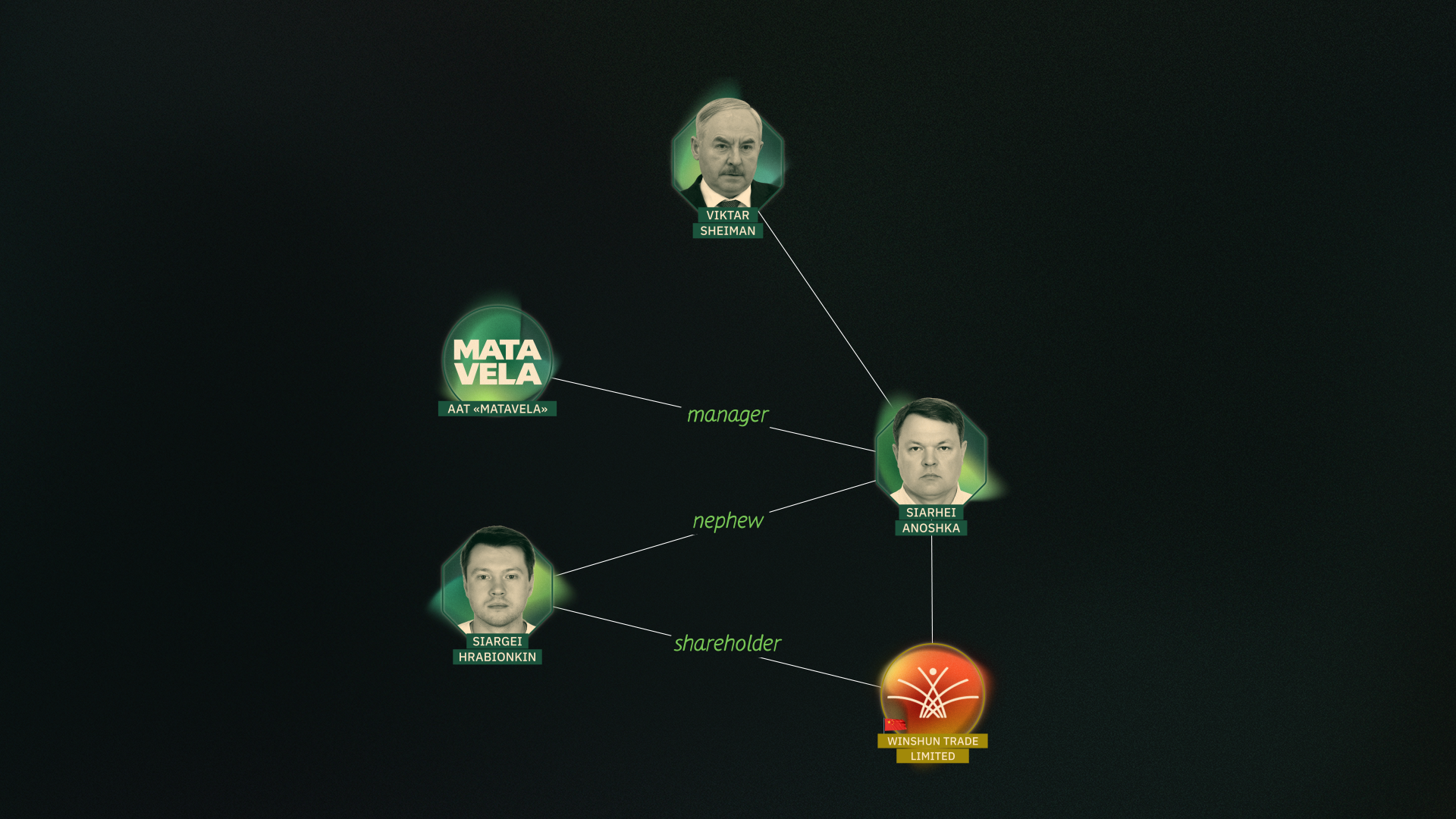
Information regarding the organizations referenced in the investigation
In this article, Brandshandel refers to Brandshandel LLC, registered in Belarus (identification number: 193674952).
In this article, Erop Group AG refers to Erop Group AG, Zug, Switzerland (liq), registered in Switzerland (identification number: CHE-114.064.834).
In this article, Hlobalkastam refers to TAA Hlobalkastam, registered in Belarus (identification number: 192532549).
In this article, Winshun Trade Limited refers to Winshun Trade Limited, registered in Hong Kong, China (identification number: 2430604).
In this article, Matavela refers to AAT Matavela, registered in Belarus (identification number: 190017558).
In this article, Motavelazavod refers to TAA MVZ, registered in Belarus (identification number: 192542699).
In this article, Komplex-Invest refers to LLC Komplex-Invest, registered in Russia (taxpayer identification number: 7730265490).
In this article, Alieksvit Ltd refers to TAA Alieksvit Ltd, registered in Belarus (identification number: 192200332).
Winshun Trade Limited was featured in one of the BIC’s previous investigations. We discovered that the company had issued a loan of more than $10 million to Komplex-Invest, a private Russian firm that, as of 2025, was responsible for constructing a luxury chalet in Sochi, allegedly for Aleksandr Lukashenko. In other words, the same company was involved in a motorcycle supply scheme linked to Viktar Sheiman’s inner circle and financed the supposedly first known overseas residence of a Belarusian politician.

As Motavelazavod’s market share shrank…
The Chinese motorcycle supply scheme was unfolding as the Russian market was experiencing rapid growth. According to industry statistics, sales of new motorcycles in Russia increased from about 15,500 units in 2022 to more than 51,000 in 2025. One possible reason could be the full-scale invasion of Ukraine. Experts at the U.S. Institute for the Study of War have noted that the Russian military has begun purchasing off-road-capable enduro motorcycles. Additionally, as car prices have increased, more Russians have opted for motorcycles.
This opened up an opportunity for the Belarusian Motavelazavod to regain its footing in one of its key markets. This is especially significant since the company manufactures enduro motorcycles similar to those featured in our investigation. However, the plant was unable to capitalize on the increased demand. State media reports indicate that the company only produced approximately 6,000 motorcycles in 2024.
Speaking to the BIC, Motavelazavod director Siarhei Manko said he was not aware of any shipments by Brandshandel. He called the declared customs value of $200 for the Hasky A10 PRO NX MSD implausible.
“Apparently, with an engine like that — a 43-horsepower one — the price seems unrealistic.... A damn bicycle costs more,” Manko said.
Meanwhile, the Eurasian Economic Union protects its market from cheap imports from third countries. Depending on engine displacement, a customs duty of 14–15% applies to the import of motorcycles. This duty is intended to increase the cost of Chinese equipment and give manufacturers from EAEU countries, including Motavelazavod, a competitive advantage. However, the findings of our investigation suggest that some imports were declared at artificially undervalued prices, effectively eliminating the competitive advantage that customs protection was intended to provide. Rather than strengthening the Belarusian manufacturer’s position in a growing market, companies associated with Viktar Sheiman’s inner circle profited by supplying Chinese motorcycles.
We sent inquiries to all parties involved in the investigation. As of the time of publication, none of them had responded.
In an investigation into the rise and fall of “glass king” Alexander Muraviev, the BIC explained why Motavelazavod never became a major market player.
Upon his release from prison, the businessman Alexander Muraviev gave an interview to journalists. BIC discovered details that he hadn't mentioned.



![[*]](/storage/page_blocks/July2026/12.png)
![[*]](/storage/page_blocks/July2026/72.jpg)
![[*]](/storage/page_blocks/July2026/102.png)
![[*]](/storage/page_blocks/July2026/22.jpeg)
![[*]](/storage/page_blocks/July2026/82.jpg)
![[*]](/storage/page_blocks/July2026/32.jpeg)
![[*]](/storage/page_blocks/July2026/62.jpg)
![[*]](/storage/page_blocks/July2026/92.jpg)