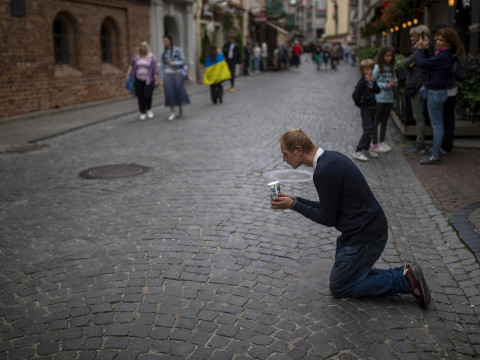


Context: Belarus plans to tie the child care benefit amount for children under 3 years of age to the recipient’s actual income. On August 11, this proposal was discussed at a meeting between Aleksandr Lukashenko and the leadership of the Council of Ministers. Currently, the benefit is paid out under a uniform scheme, regardless of how much the family earned before maternity leave. However, the authorities want to make the system more targeted.
On August 12, 2026, Maksim Kharyn, the host of the Belarusian Radio First National Channel’s political radio show Ekspertnyi Klub, claimed that Belarus pays higher benefits to families with children than neighboring Latvia.
“Look, Latvia pays a monthly benefit — these are approximate average figures, but still — of €298 per child. Let’s use euros for the comparison. Belarus, meanwhile, pays approximately €300. So Belarus, with its economic prosperity and prices that are several times lower than in Latvia for everything from food to social services, has outpaced Latvia when it comes to monthly child benefits,” Kharyn said.
Then, he compared one-time childbirth allowances.
“The one-time childbirth allowance paid by Latvia is €600. Meanwhile, pay close attention to this: in Belarus, the one-time childbirth allowance is €1,470. That’s for one child. <...> For a second child, the benefit exceeds €2,000. Draw your own conclusions, Latvia and its residents,” the host stated.
Kharyn’s figures were based on real benefit amounts. In Latvia, parents indeed receive a monthly government child benefit of €298 for children up to 18 months of age. The one-time childbirth allowance is €600.
The amounts are roughly the same in Belarus. As of August 1, the monthly childcare benefit for children under three years of age is about €310. A payment of about €1,500 is made upon the birth of the first child. For the second and subsequent children, the payment is slightly more than €2,100.
However, these figures do not support the conclusion that Belarus provides more generous support to families with children than Latvia does. Kharyn only compared a portion of the benefits and failed to mention the benefit received by working parents with social insurance in Latvia. The amount of this benefit is dependent on the parent’s previous salary. If the benefit is claimed over 13 months, it amounts to 60% of their previous earnings. If spread over 19 months, it amounts to just over 40%. At the beginning of 2026, the average salary in Latvia exceeded €1,800. Therefore, the total amount an average working parent in Latvia can receive while on parental leave ranges from approximately €1,000 to €1,400 per month.
In Belarus, there is no such benefit. Even if the childcare benefit for children under three is tied to the recipient’s income, it would still remain a single monthly benefit. However, in Latvia, there are two types of payments: a fixed portion and a variable benefit based on the parent’s previous earnings.
The one-time childbirth allowance in Latvia is indeed lower than in Belarus. However, this comparison is still incomplete because the local government plays a significant role. Municipalities may provide additional payments to new parents. For instance, Jūrmala residents receive an extra €1,500 for each newborn. As a result, a family receives more than €2,000 with this supplement.
Additionally, Latvia provides a benefit from age one through age 16, and up to age 20 if the child continues their education. There is no similar payment in Belarus. In Latvia, the allowance ranges from €25 to €100 per child per month, depending on family size. The more children there are, the higher the amount per child. For two children, a family receives €100 per month until they turn 16; for four children, the amount is €400 per month.
In other words, Maksim Kharyn only compared Belarus and Latvia in terms of basic benefits, such as the monthly payment for a young child and the one-time payment upon birth. However, he did not take into account Latvia’s benefits for employed parents covered by social insurance, municipal supplements, or benefits for older children. Therefore, it is incorrect to conclude that Belarus pays families with children more than Latvia does.


Co-funded by the European Union. Views and opinions expressed are however those of the author(s) only and do not necessarily reflect those of the European Union or the European Health and Digital Executive Agency (HaDEA). Neither the European Union nor the granting authority can be held responsible for them.