


This investigation reveals how companies linked to Cyprus's former president Nicos Anastasiades helped Belarusian businessman Yury Chyzh, one of Lukashenko's key "bagmen," circumvent EU sanctions and participate in massive smuggling schemes.
The Sanctions Evasion Scheme
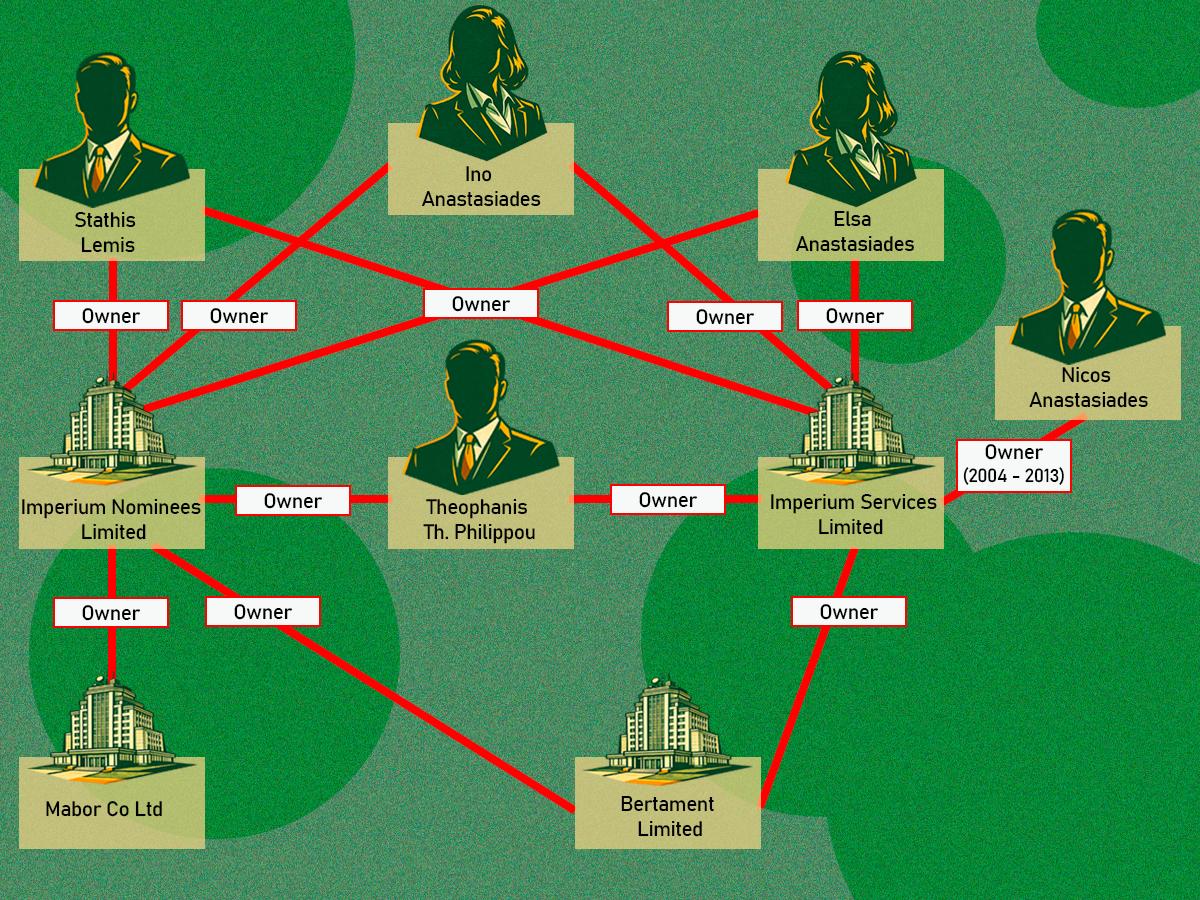
From 2012 to 2015, the EU sanctioned Yury Chyzh and several of his companies for financially supporting Lukashenko's regime. However, two Cypriot companies that co-owned Chyzh's firm STAA TriplePharm — Welgro Services Limited and Profax Investments Limited — were not sanctioned. These companies were owned and managed by Imperium Nominees Limited, which belonged to Elsa Anastasiades (the former president's daughter) and his long-time business partners.
The investigation found evidence that the sanctioned Belarusian company TriplePharm continued financial transactions with its Cypriot owners during the sanctions period. In 2013-2014, TriplePharm repaid debts to Profax, and the money was then withdrawn as "administrative expenses" — potentially violating EU sanctions designed to freeze such economic activity.
Direct Presidential Involvement
Nicos Anastasiades wasn't just indirectly connected through his daughter — he was directly involved. Until 2013, he co-owned Imperium Services Limited, which served as secretary for Profax during the sanctions period. Additionally, his family law firm Nicos Chr Anastasiades & Partners acted as legal adviser to these companies throughout this time.
The Multi-Billion Dollar Smuggling Operation
The Anastasiades family companies played a central role in what media described as one of Belarus's largest smuggling schemes — the re-export of Russian gasoline disguised as solvents and diluents in 2011-2012. This scheme allowed Belarusian companies to avoid paying export duties to Russia worth potentially billions of dollars.
At the heart of this operation was Mabor Co Limited, owned and directed by Imperium Nominees (belonging to Anastasiades's daughter and partners). The company's secretary and legal adviser were firms co-owned by Anastasiades himself. In 2011 alone, Mabor's turnover exceeded $4 billion — five times higher than the previous year.
Vacations for Lukashenko's Circle
The investigation uncovered that in January 2012, Bertament Limited (another company in the Anastasiades network) paid $25,000 for a 16-day of accommodation at a ski resort for a group of 16 people connected to Lukashenko. The list included businessmen Yury Chyzh and Alexander Shackutin, beauty queens, singers, and even Lukashenko's confessor. This vacation coincided with Lukashenko's own stay at the same resort, where he was meeting with then-Russian President Dmitry Medvedev.
Response from Those Involved
Yury Chyzh refused to comment. Former President Anastasiades claimed he was unaware of the issues and threatened legal action if the allegations were published. His business partner Theophanis Philippou denied all allegations and also threatened defamation lawsuits.
For the first time, a top-ranking European politician has been caught participating in а sanctions evasion. BIC established that a company owned by the former president of Cyprus was involved in the violations. What’s more, his firms helped implement smuggling schemes worth billions of dollars, and a company co-owned by his daughter paid for vacations for Aleksandr Lukashenko’s entourage.
The investigation was prepared in partnership with the Cypriot outlet CIReN, German ZDF and Paper Trail Media, Austrian Der Standard, the Organized Crime and Corruption Reporting Project, OCCRP, with the support of Rabochy Ruch and CyberPartisans and documents from ICIJ databases.
At the beginning of 2026, the Republic of Cyprus assumed the presidency of the Council of the European Union. Among the priorities for its six-month term, Nicosia announced the “proper implementation of EU sanctions against Russia and Belarus.” Previously, however, Cyprus had distinguished itself by once blocking sanctions against official Minsk.
On September 21, 2020, the Council of the European Union failed to agree on a package of restrictive measures against Belarusian officials accused of falsifying the results of the presidential election and being involved in repressions — Cyprus blocked it. According to media reports, Nicosia was attempting to secure EU sanctions against Turkey. The Republic of Cyprus and Greece are in a long-standing conflict with Turkey following the 1974 invasion of Cyprus and the division of maritime areas. In an interview with OCCRP, American-British financier and anti-Kremlin political lobbyist Bill Browder did not rule out the possibility that the blocking of sanctions against Belarusian officials could be explained by Cyprus’s close financial ties with Russia.
As BIC has established and is disclosed below, several years before that incident, the family law company of the then-president of Cyprus, Nicos Anastasiades, serviced a businessman from the entourage of Aleksandr Lukashenko and helped him circumvent EU sanctions imposed for violations during the 2010 election and the subsequent repressions.
Service amid sanctions
From 2012 to 2015, the EU imposed sanctions on Yury Chyzh and a number of his companies, including STAA TriplePharm (a joint venture limited liability company as defined by the law of Belarus), for financial support of the Aleksandr Lukashenko regime. However, two co-owners of TriplePharm were not placed under sanctions — the Cypriot companies Welgro Services Limited and Profax Investments Limited (hereinafter — Welgro and Profax). [*] [*] They were owned and managed by Imperium Nominees Limited (hereinafter — Imperium Nominees), also registered in Cyprus. [*] [*] [*] [*] Imperium Nominees belongs to the daughter of the then-president of Cyprus, Nicos Anastasiades, Elsa Anastasiades, and his long-time business partners, Stathis A. Lemis and Theophanis Th. Philippou. [*]
The financial statements of the Cypriot owners of TriplePharm indicate possible interaction with their sanctioned Belarusian asset. In particular, in 2013, TriplePharm had debts to Profax, and in 2014, the debts disappeared. Profax’s report from that same year shows the incoming funds from repayment of those loans. It appears that the sanctioned Belarusian company returned the money to its European owner. [*] [*]
Such transactions could be in breach of EU sanctions. In addition, the sanctions violation may have occurred because Yury Chyzh claims to be the real owner of Profax. This follows from a letter he sent to the Department of Registrar of Companies and Intellectual Property of the Republic of Cyprus, in which the businessman directly wrote that he owned this company from 2008 to 2017 “through Imperium Nominees.” BIC obtained this letter with the assistance of Rabochy Ruch. [*]
Conflict between Yury Chyzh and his family over Cypriot companies
In May 2023, Yury Chyzh told the newspaper Narodnaya Volya that his family had “taken advantage of the situation and assumed control over the majority of the companies” while he was under investigation. In the same interview, he stated that he had transferred the business to his children when he first came under EU sanctions, but insisted that he had always remained the ultimate beneficial owner.
In an attempt to regain control over the Cypriot companies, Chyzh filed a claim with the Minsk Economic Court. In July 2023, during a closed hearing, the court refused to consider his lawsuit seeking recognition of ownership rights over Welgro and Profax, which hold a 90% stake in the authorized capital of TriplePharm.
According to documents obtained by BIC, in September 2025 another court — the Economic Court of the Minsk Region — accepted Chyzh’s claim. A hearing on this case is scheduled for May 2026.
Thus, at the time when European sanctions were in force against Yury Chyzh — which implied freezing the economic activity of his companies — one of the businessman’s firms, registered in the EU under a provider company belonging to the family of the then-president of Cyprus, continued to send and receive money. In particular, Profax, having received the repayment of loans from TriplePharm, withdrew these funds by designating them as administrative expenses. [*]
To understand whether this is legal, the BIC contacted the Institute of Certified Public Accountants of Cyprus (ICPAC) to clarify under what conditions a Cypriot company may keep operating if its owner, director, or manager is subject to sanctions. In its reply, the institute stated that sanctions are intended not to dissolve a legal entity, but to limit its financial capabilities.
"Where a director/manager cannot be removed, relevant measures should be put in place to ensure that no benefit is transferred (directly or indirectly) to the designated director/manager, either by way of funds (salary/benefits in kind) or through the exercise of their decision-making powers. [...] The ASP can effectively prevent the designated person’s access to the funds by freezing the provision of its services," ICPAC stated.
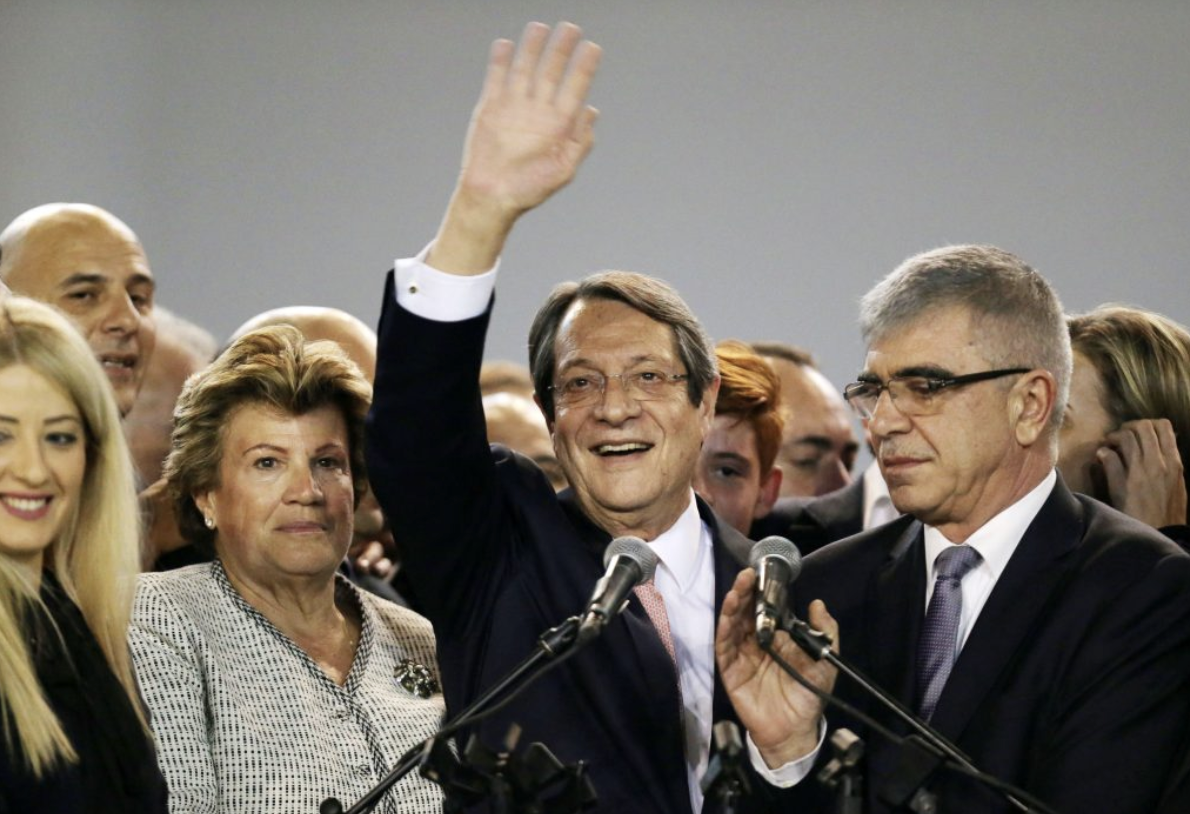
Not only was the former president of Cyprus indirectly involved in this scheme, he was also directly involved. Until 2013, Nicos Anastasiades was a co-owner of Imperium Services Limited. It served as the secretary of Profax, including at the time when Yury Chyzh was under EU sanctions.
It is unlikely that the Anastasiades family can invoke ignorance of sanctions legislation. The legal adviser of Profax at the time of the transactions described above was the Nicos Chr Anastasiades & Partners company. It was founded in 2001 by Nicos Anastasiades himself, who withdrew from ownership only two days before taking the oath of office as president of Cyprus in February 2013. The partners in the law firm remained unchanged until its dissolution in 2022: the former Cypriot president's daughters Elsa and Ino Anastasiades, along with Stathis Lemis and Theophanis Th. Philippou — both of whom we identified earlier as partners of the president's daughter in Imperium Nominees. [*] [*] [*]
Billions in smuggling profits and “deposit haircut”
The companies of Nicos Anastasiades were connected to a well-known Belarusian scheme that media outlets described as smuggling — the re-export of Russian gasoline under the guise of solvents and diluents in 2011–2012. Under the agreement in force at the time between Minsk and Moscow, Belarus was required to pay export duties to the budget of the Russian Federation amounting to up to half of the global price of re-exported Russian petroleum products. However, Belarusian companies evaded this by declaring Russian gasoline and diesel, when exporting them from Belarus, as solvents, diluents, biodiesel, and lubricating oils.
“Businessmen close to Lukashenko earned insane amounts of money in a very short period. Until Russia came to its senses and, so to speak, clamped down on its crafty partner,” economic observer Andrei Makhouski explained in a comment to BIC.
The central entity in this scheme was Mabor Co Limited (hereinafter — Mabor). The main smuggling flows passed through it. The company was owned and directed by Imperium Nominees Limited, which belonged to the daughter and business partners of Nicos Anastasiades. The secretary and legal adviser were companies co-owned by Anastasiades himself — Imperium Services Limited and Nicos Chr Anastasiades & Partners. [*] [*] [*]
Among the major participants in this scheme were named the Belarusian firms SZAT TripleEnergo (a closed joint stock company as defined by the law of Belarus) and TDA Belnaftahaz (an additional liability company as defined by the law of Belarus), co-owned by Aliaksei Aleksin, at that time a business partner of Yury Chyzh. According to documents that BIC obtained with the assistance of Rabochy Ruch, in 2010, 91% of Belnaftahaz’s revenue consisted of trade with Mabor — almost a quarter of a billion dollars. For the first half of 2012, Mabor had contracts with Belnaftahaz for the supply of “solvent” worth $1.3 billion. [*] [*] [*] [*] [*]

Another channel through which Mabor received petroleum products from Belarus was One Energy UAB, registered in Lithuania. It belonged to Vilius Kavaliauskas — the owner of the Lithuanian provider company UAB Lewben, which serviced Aliaksei Aleksin and Aleksandr Zaitsev (both under European and U.S. sanctions at the time of publication). Among its suppliers, One Energy UAB listed the Belarusian firms TAA Triple (a limited liability company as defined by the law of Belarus), TripleEnergo, and Belnaftahaz. In 2011, Mabor’s turnover amounted to more than $4 billion — five times higher than the previous year. [*] [*]
A year after the completion of the “diluents” scheme, president Anastasiades and Mabor became embroiled in a scandal in Cyprus.
In 2013, the company withdrew more than $20 million from Cyprus — shortly before the planned “deposit haircut.” The “deposit haircut” of large depositors in Cypriot banks was a condition set by the Eurogroup for Cyprus to receive $10 billion in order to save the country’s banking sector from collapse. Cypriot media suspected then-president Nicos Anastasiades of possibly using insider knowledge about the partial freezing of deposits to warn the owners of Mabor. Anastasiades’s firm, Nicos Chr Anastasiades & Partners, rejected these accusations.
We were unable to find a definitive answer to the question of who was the real beneficiary of Mabor. Information from the company’s financial statements may point to possible individuals who controlled it. They list related companies: together with Mabor, they could, but did not necessarily have to, belong to the same owner. Based on the available documents, at least one of these companies was linked to a corporate network associated with Yury Chyzh. Another was owned, at that time, by an employee of the provider company Lewben, and from 2016 by the Lithuanian business partner of Yury Chyzh, Vitold Tomasevskij. Tomasevskij also participated in the “solvents” scheme and, together with Chyzh, owned the chain of Minsk hypermarkets ProStore. [*] [*]
Contracts on behalf of Mabor were signed by Theophanis Th. Philippou, the previously mentioned partner of the former president of Cyprus. From 2008 to 2011, Philippou personally visited Belarus seven times. In response to BIC’s question about the purpose of these trips, he said they were for personal matters, which he refused to specify. [*] [*] [*]
Vacation with models, Forex trading, and casinos
In addition to the cooperation of Cypriot companies with sanctioned Belarusian entities and participation in the “solvents” scheme, BIC found other evidence of connections between the former president of Cyprus and his partners with the “wallets” of Aleksandr Lukashenko — and with Lukashenko himself.
In January 2012, at the height of the smuggling scheme, Bertament Limited, a Cypriot company, concluded an agreement with the Belarus recreation center at the Krasnaya Polyana ski resort for a 16-day stay of a group of Belarusians. Theophanis Th. Philippou, a business partner of the former president of Cyprus, appears on the agreement on behalf of Bertament Limited. With the assistance of Rabochy Ruch, we found a list of these recreation center guests who checked out on the date specified in the agreement. [*] [*] [*]
The $25,000 invoice included accommodation at the Belarus recreation center for 16 persons: businessmen Yury Chyzh, Alexander Shackutin and Sergei Teterin; hockey player Mikhail Zakharov; biathlete Sergei Bulygin; Chairman of the Board of ANT Ryhor Kisel; Miss Supranational-2012 Katsiaryna Buraya; artistic director of the ensemble Verasy Vasili Raintchik; singer Viktoryia Aleshka; Miss Minsk finalist and later director of the modeling agency of the National School of Beauty Yuliya Tsurykava; Miss Belarus finalist Viktoryia Zubrytskaya; the first teacher of Nikolai Lukashenko Maria Bogomolova; employee of the Palace of the Republic Tatsiana Matveyeva, who two years later would become a business partner of Sergei Teterin; employee of Belteleradiocompany Palina Shuba; model and actress of the Yanka Kupala Theater Marta Holubeva. The sixteenth was the confessor of Aleksandr Lukashenko, Archpriest Fiodar Pouny.

This vacation coincided with the stay at the same resort of Aleksandr Lukashenko. There, the politician combined negotiations with the president of Russia, Dmitry Medvedev, and a short-term vacation.
The nominal owners of Bertament, which paid for the vacation, were Imperium Nominees and Imperium Services. At that time, the majority shareholders in these companies were Elsa Anastasiades and Nicos Anastasiades, respectively. We have grounds to believe that the real beneficiary of Bertament was Yury Chyzh. Profax’s 2021 report includes the line item “Loans from Related Companies” for $5 million. The same document states that Bertament issued the loan for the same amount. Above, we reported that Chyzh named himself the real beneficiary of Profax. At the time of publication, this company, as well as Welgro, is registered in the name of his son Uladzimir. We also see that in the following year, Yury Chyzh paid for a similar vacation through another company. [*] [*] [*]
In 2013, Theophanis Th. Philippou continued working with Belarus, signing commercial offers for the supply of Belarusian petroleum products to Western buyers. One such offer on the letterhead of Edena Investments Limited bears his name and signature as well as two seals: Edena Investments Limited and Imperium Nominees Limited. Edena Investments Limited became scandalously known in Belarus in 2016, during the trial of Kazbek Yaprintsev, the son of the former business partner of Yury Chyzh. In reports about this trial, media outlets stated that Kazbek was the co-owner of this company and received prepayments for petroleum products into this company, which, according to his testimony in court, he later lost on the Forex market. [*]
The family provider companies of the former president of Cyprus also serviced the firm Roslaton Holdings Limited, which until 2019 owned a stake in the Minsk casino Shangri La. In a report to the Cypriot authorities, Roslaton Holdings Limited listed as a related company the Emirati firm Petrotrade, which belongs to Dzmitry Aleksin, the son of the “wallet” of Lukashenko, Aliaksei Aleksin. [*] [*] [*]
To give them an opportunity to comment, we have called and sent written requests to all the people and companies mentioned in this investigation. Yury Chyzh refused to answer our questions. Former Cypriot president Nicos Anastasiades replied that he was unaware of the issue and therefore unable to answer our questions. He added that if we "persisted in our allegations", he would be left with "no other choice but to take legal action." Theophanis Philippou initially said he remembered the company Mabor but not his former partners, and later threatened consequences if we published "anything which is not accurate." He also responded in writing on behalf of Nicos Chr Anastasiades & Partners LLC. In his letter, he "definitely denied all allegations" and characterised our questions as "groundless, unproven and appearing to be based on incorrect assumptions." Philippou further threatened "legal proceedings for defamation" and raised the prospect of compensation for "damages".


![[*]](/storage/page_blocks/March2026/1. владельцы трайплфарм2.png)
![[*]](/storage/page_blocks/March2026/1.12.png)
![[*]](/storage/page_blocks/March2026/2. валодала2.png)
![[*]](/storage/page_blocks/March2026/3 3.png)
![[*]](/storage/page_blocks/March2026/3 22.png)
![[*]](/storage/page_blocks/March2026/4 зарэг у кіпры2.png)
![[*]](/storage/page_blocks/March2026/5 належала дачцэ2.png)
![[*]](/storage/page_blocks/March2026/6 запазычанасці зніклі2.png)
![[*]](/storage/page_blocks/March2026/73.png)
![[*]](/storage/page_blocks/March2026/83.png)
![[*]](/storage/page_blocks/March2026/9 аформіўшы гэта як адміністратыўныя2.png)
![[*]](/storage/page_blocks/March2026/10 на момант апісаных вышэй транзакцыяў2.png)
![[*]](/storage/page_blocks/March2026/11 заснаваў сам3.png)
![[*]](/storage/page_blocks/March2026/124.png)
![[*]](/storage/page_blocks/March2026/13 Валодала кампаніяй2.png)
![[*]](/storage/page_blocks/March2026/14 была дырэктарам2.png)
![[*]](/storage/page_blocks/March2026/15 належала дачцэ і бізнес-партнёрам Нікаса2.png)
![[*]](/storage/page_blocks/March2026/16 ТрайплЭнерга2.png)
![[*]](/storage/page_blocks/March2026/17 52.png)
![[*]](/storage/page_blocks/March2026/17 72.png)
![[*]](/storage/page_blocks/March2026/18 аймаў гандаль з фірмай Mabor 2.png)
![[*]](/storage/page_blocks/March2026/19 мела кантракты з 2.png)
![[*]](/storage/page_blocks/March2026/20 указвала беларускія фірмы2.png)
![[*]](/storage/page_blocks/March2026/21 вырас у пяць разоў 2.png)
![[*]](/storage/page_blocks/March2026/22 12.png)
![[*]](/storage/page_blocks/March2026/22 валодаў, разам з Чыжом, сеткай 2.png)
![[*]](/storage/page_blocks/March2026/23 12.png)
![[*]](/storage/page_blocks/March2026/23 падпісваў2.png)
![[*]](/storage/page_blocks/March2026/242.png)
![[*]](/storage/page_blocks/March2026/252.png)
![[*]](/storage/page_blocks/March2026/26 спіс гэтых гасцей2.png)
![[*]](/storage/page_blocks/March2026/27 выязджалі ў дзень, указаны ў дамове2.png)
![[*]](/storage/page_blocks/March2026/29 кампанія,2.png)
![[*]](/storage/page_blocks/March2026/30 welgro2.png)
![[*]](/storage/page_blocks/March2026/312.png)
![[*]](/storage/page_blocks/March2026/332.png)
![[*]](/storage/page_blocks/March2026/35 рослатон2.png)
![[*]](/storage/page_blocks/March2026/36 валодала2.png)
![[*]](/storage/page_blocks/March2026/37 справаздачы2.png)