


This investigation reveals how companies linked to Viktar Sheiman’s circle, a close associate of Aleksandr Lukashenko, have continued supplying sanctioned European luxury cars to Russia through Belarus, despite tightened EU restrictions and previous exposés.
The Core Scheme
The BIC uncovered that sanctioned European cars — banned from export to Russia since 2022 — are still reaching Russian buyers through an elaborate network of Belarusian and Cypriot companies. The investigation identified a Russian company called OOO Astrata as a key player, which purchased at least 19 sanctioned European cars worth $1.96 million between 2023 and 2025. Notably, more than half of these vehicles imported in the last two years were initially registered in Ukraine.
Key Players and Connections
The network centers around Andrei Svirydau, who served as deputy to Viktar Sheiman from 2019 to 2021. Since July 2025, Svirydau has owned 80% of Astrata. The investigation traces connections through multiple entities:
- Rostumel Holding Limited (Cyprus) - shipped German cars from the Netherlands to St. Petersburg
- TAA NewInvestGrup and TAA LegionGrupInvest (Belarus) - exported cars to Russia through 2024-2025
- Dimicandum Invest Holding LTD (Cyprus) - provided loans to the companies involved
Financial documents from 2023 confirm these companies are interconnected through loan agreements, creating a coordinated sanctions-busting operation.
Real-World Evidence
The investigation even identified specific vehicles and their final buyers. One Mercedes-Benz V300d involved in a Moscow accident was traced back through the scheme. Using VIN numbers, BIC traced several cars to Russian legal entities, including Irvin 2, a pharmaceutical wholesaler and construction firms.
The Broader Impact
As German economist Benjamin Hilgenstock explained to BIC, this case highlights fundamental challenges in sanctions enforcement when they're not universally applied. The continued circumvention undermines sanctions against Russia and risks triggering new restrictions on Belarus itself — consequences that would ultimately harm ordinary Belarusians.
Despite written inquiries, none of the companies or individuals named in the investigation responded to BIC at the time of publication.
Belarusian companies continued to supply European cars to Russia, even after restrictions were introduced and tightened, and violations of the sanctions regime were publicised. In the summer of 2024, the BIC exposed a scheme involving the illegal re-export of goods by firms linked to Viktar Sheiman, an associate of Aleksandr Lukashenko. In this investigation, we identified new participants in the chain, traced the supply routes, and discovered the final recipient of the banned cars. Such schemes undermine the effectiveness of sanctions against the aggressor country and could lead to new restrictions on Belarus. The economic consequences of these restrictions will affect ordinary Belarusians.
The investigation was prepared in partnership with the Rabochy Ruch initiative and the Ukrainian Slidstvo.Info edition, with support from the Belarusian CyberPartisans hacker group.
In September 2025, an accident occurred in Moscow involving a Mercedes-Benz and another vehicle. According to the State Traffic Police, the premium car only suffered minor damage, with possible scratches and scuffs on the left side. At first glance, this appears to be just one of the many accidents that occur on Moscow’s roads every day. What sets it apart is that this Mercedes-Benz was allegedly part of a scheme to supply sanctioned cars to Russia via Belarus. [*]
In mid-March 2022, the EU banned the export of luxury goods to Russia.
These included cars costing more than €50,000, such as Mercedes-Benz, Ferrari, and Porsche models. In June 2023, the EU introduced a new sanction package banning the supply of cars of any value in certain categories.
Scheme two: Astrata joins the same shady companies
In summer 2024, the BIC revealed details of an illegal scheme to re-export premium cars from Ukraine to Russia. The investigation involved companies and individuals associated with Viktar Sheiman, who was head of the Presidential Property Management Department until mid-June 2021. Prohibited deliveries involving Belarusian companies continued in 2024 and 2025, including those passing through our country. We discovered new links within this chain, as well as connections to old affiliated structures.
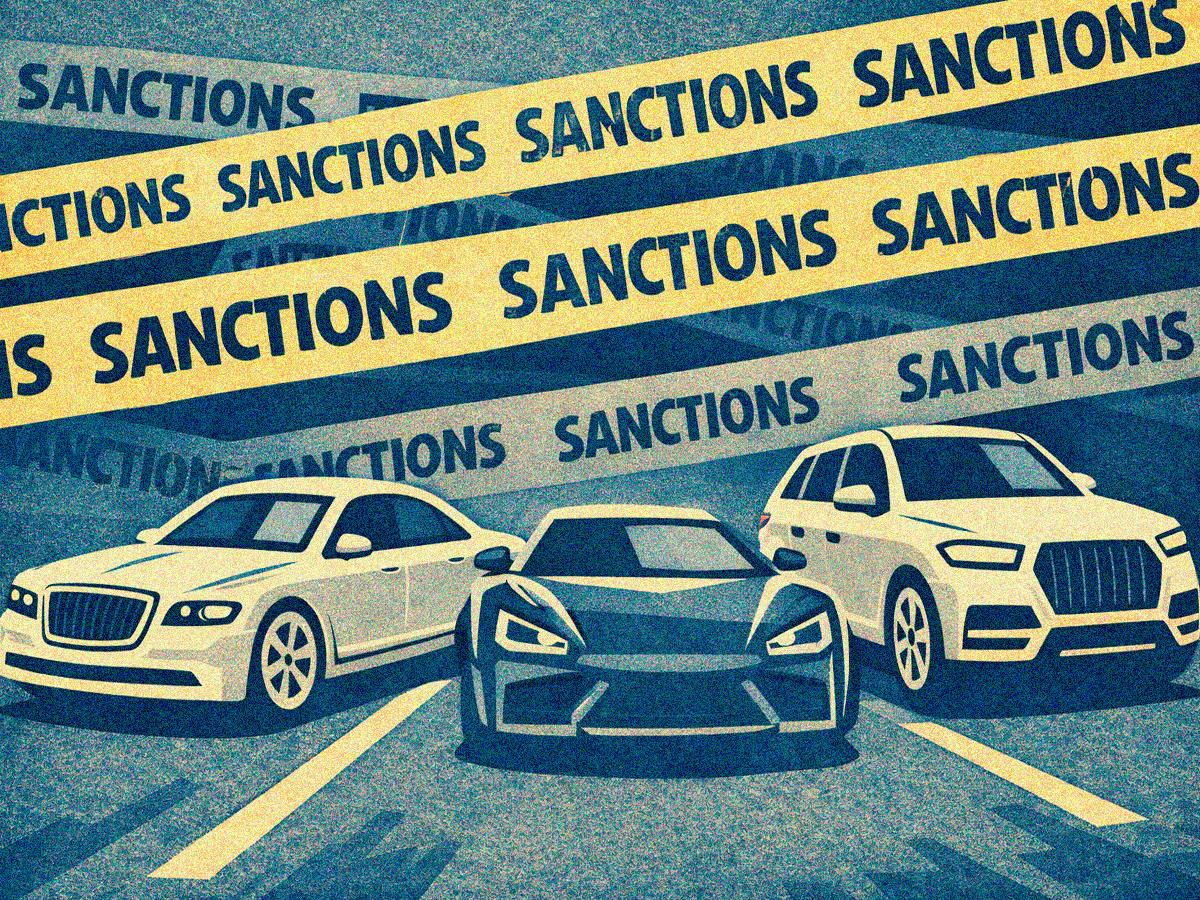
In 2023, 2024, and 2025, the Russian OOO Astrata (a limited liability company as defined by the law of the Russian Federation) purchased sanctioned European-made cars from firms associated with Belarus. The company bought at least 19 cars, with a total declared value of $1.96 million. This breaks down as follows: $1.13 million in 2023; $604,000 in 2024; and $222,000 in 2025. Initially, over half of all cars imported in the last two years were registered in Ukraine.
Since July 9, 2025, Andrei Svirydau, a figure in several of our investigations, has owned 80% of Astrata. [*] [*] [*] From 2019 to 2021, this Belarusian citizen served as deputy to Viktar Sheiman, who was responsible for handling Aleksandr Lukashenko’s property management affairs at the time. At the time of publication of the investigation, the remaining fifth part of Astrata was owned by Ekaterina Kornienko, a Crimean-born with a Russian passport. She had full ownership of the firm until mid-2025. Another company also allows us to trace the connection between Kornienko and Svirydau. Since March 2022, Kornienko has held the position of director at OOO PIK (a limited liability company as defined by the law of the Russian Federation), which was owned by the Cypriot company Rostumel Holding Limited (hereinafter — Rostumel) from April 2019 to October 2022. [*] [*] [*] As stated in the power of attorney, Svirydau was employed as Rostumel’s CFO as of June 2024. [*]
Consignor and consignee rolled into one
The Cypriot company associated with Svirydau is among those shipping sanctioned cars to Russia. At the end of 2024, Rostumel was shipping German cars from the Netherlands via St Petersburg. According to declarations available to the BIC, the vehicles were processed at warehouses in the Ugolnaya Harbour port area.
Alex Prezanti, a UK barrister and co-director of the State Capture Accountability Project, told BIC that he could not see how the cars’ journey from the Netherlands to St. Petersburg could be legally explained.
“EU persons are prohibited from selling, supplying, transferring, or exporting such goods to a person in Russia or for use in Russia… I do not know how or why this vehicle managed to clear Dutch customs,” said the lawyer, concluding that the Cypriot company had delivered the car in violation of the sanctions.
We sent a written request to the Dutch customs authorities, asking them to explain how it was possible for prohibited goods to be shipped from an EU country. We have not received a response at the time of publication.

In 2024, two Belarusian legal entities, TAA NewInvestGrup and TAA LegionGrupInvest (limited liability companies as defined by the law of Belarus), also exported cars to Russia. The former continued shipments into 2025. Dimicandum Invest Holding LTD (hereinafter — Dimicandum) owned it outright from June 2018 to October 2024, with Andrei Svirydau serving as CFO during this period. He has also been managing LegionGrupInvest since June 2024. [*] [*] [*] [*]
Between January and July 2025, Belarusian companies imported into Russia European-made cars subject to EU sanctions with a total value of approximately $1.8 million. We do not know how many of these were delivered in violation of the law. Although the EU banned supplies to Belarus in July 2024, some cars might still be imported into the country before then.
(Non)circumstantial evidence
The above companies’ participation in the sanctions circumvention scheme is no coincidence. We obtained financial documents for 2023 from Rabochy Ruch that confirm their connection. In June, the Cyprus-based company Dimicandum entered into two loan agreements with NewInvestGrup. [*] [*] Also in June, it provided a loan to Astrata. [*] Additionally, the Russian company, which is partly owned by Svirydau, has the same name as TOV Astrata (a limited liability company as defined by the law of Ukraine), a Ukrainian company involved in the illegal re-export of cars with Rostumel. [*] [*]
In 2023, the Security Service of Ukraine exposed a plot to illegally export Ukrainian goods, including automobiles. The property of Ukrainian businessman Vitaliy Bobyr was searched in the spring of that year as part of the case. Law enforcement officials seized documents, seals, and electronic media linked to Rostumel, the company owned and directed by Vitalii’s mother, Iryna Bobyr. [*] [*] The businessman himself was listed as an employee of NewInvestGrup between 2023 and 2024.
A BIC journalist contacted Bobyr, but the conversation was not productive. First, the businessman suggested that our “stories” had been commissioned by his enemies. Then, he recommended that the journalist go to war. The only substantive thing Bobyr said was that he allegedly has nothing to do with Rostumel, Astrata, NewInvestGrup, or LegionGrupInvest, “neither physically nor legally”.
The end customer
Using VINs (unique 17-character codes assigned to vehicles at the factory), we were able to identify the final buyers of some of the cars imported in violation of sanctions. Several cars are registered to legal entities, including OOO PF VIS, OOO Stone-XXI, and OOO Instanta Rus (limited liability companies as defined by the law of the Russian Federation).
Thanks to the data provided by Rabochy Ruch, we identified the owner of the Mercedes-Benz V300d AWD involved in the aforementioned accident and how the car came into the owner’s possession. In January 2024, before the ban on exporting cars to Belarus came into effect, NewInvestGrup, associated with Svirydau, signed a contract with a Polish entrepreneur of Belarusian origin to purchase the car, which was delivered to Russia in February. At the time of the accident, the car was registered to a Russian company, OOO Irvin 2 (a limited liability company as defined by the law of the Russian Federation). It is engaged in the wholesale distribution of pharmaceutical products. [*]

Regime issues
In a written comment to BIC, German economist and sanctions expert Benjamin Hilgenstock explained that “the continued re-export of EU-origin vehicles <…> shows the fundamental challenges of a sanctions regime that is not universal <…> Sanctions enforcement is complicated by the absence of secondary sanctions <…> There is significantly less pressure for actors in third countries to comply.”
The ban on exporting certain types of cars to Russia and later to Belarus was imposed to curb trade in non-essential goods and to restrict the aggressor country’s material resources. Any companies found to be assisting in circumventing sanctions risk the imposition of new restrictions on Belarus, further isolating the country from the global community. These economic consequences may also affect ordinary Belarusians.
The BIC sent written enquiries to Andrei Svirydau and Ekaterina Kornienko, as well as to the companies featured in this investigation. At the time of publication, we had not received any responses.

![[*]](/storage/page_blocks/February2026/110.png)
![[*]](/storage/page_blocks/February2026/21.png)
![[*]](/storage/page_blocks/February2026/31.png)
![[*]](/storage/page_blocks/February2026/41.png)
![[*]](/storage/page_blocks/February2026/51.png)
![[*]](/storage/page_blocks/February2026/61.png)
![[*]](/storage/page_blocks/February2026/71.png)
![[*]](/storage/page_blocks/February2026/81.png)
![[*]](/storage/page_blocks/February2026/91.png)
![[*]](/storage/page_blocks/February2026/101.png)
![[*]](/storage/page_blocks/February2026/111.png)
![[*]](/storage/page_blocks/February2026/121.png)
![[*]](/storage/page_blocks/February2026/131.png)
![[*]](/storage/page_blocks/February2026/141.png)
![[*]](/storage/page_blocks/February2026/151.png)
![[*]](/storage/page_blocks/February2026/161.png)
![[*]](/storage/page_blocks/February2026/171.png)
![[*]](/storage/page_blocks/February2026/181.png)
![[*]](/storage/page_blocks/February2026/191.png)
![[*]](/storage/page_blocks/February2026/201.png)